

Getting into a Spanish university as an Indian student is entirely achievable. It is also the stage where most applications go wrong, not because of academic merit, but because of paperwork done incorrectly, deadlines missed by a few weeks, or a misunderstanding of how Spain evaluates Indian qualifications.
Spain does not have a blanket equivalency agreement with India. What it has is a structured evaluation process and understanding that process is the first thing to do before you touch a single application form.
The evaluation depends on which level you are applying at.
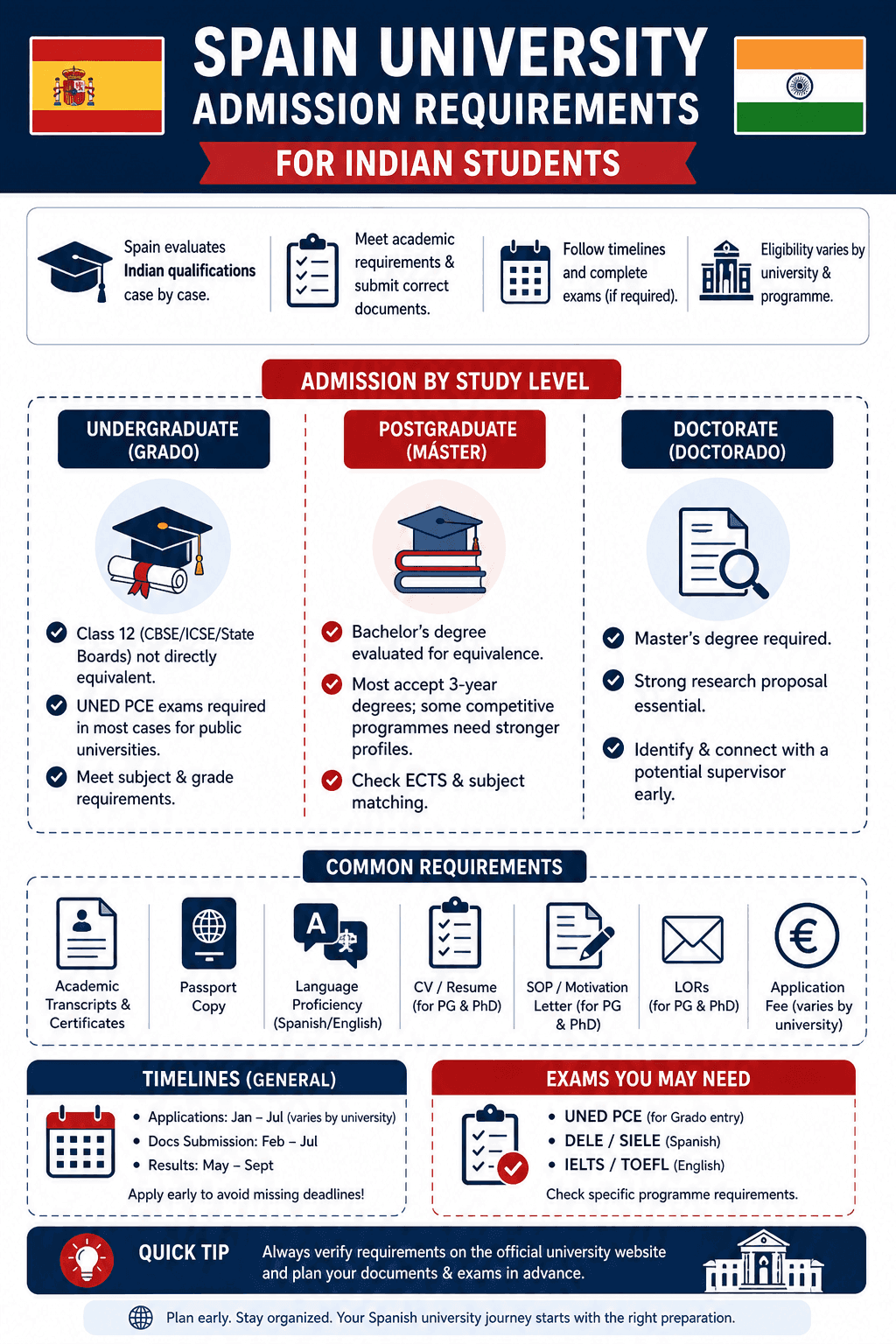
For undergraduate (Grado) entry, Class 12 from CBSE, ICSE, or State Boards is not automatically considered equivalent to the Spanish Bachillerato in Spain. In most cases, students must complete additional requirements such as the UNED PCE examinations, which apply to public universities and most standard private admissions.
For postgraduate (Máster) entry, universities assess Indian bachelor’s degrees for academic equivalence. Eligibility varies by programme, and while many accept three-year degrees, some competitive courses may require stronger academic profiles or equivalent preparation.
For doctoral (Doctorado) programmes, a completed Master’s degree and a strong research proposal are required. In many cases, identifying a suitable supervisor in advance is an important first step in the admission process.
For Indian students entering undergraduate programmes in Spain, the UNED PCE (Pruebas de Competencias Específicas) is a widely used pathway for university admission. It is accepted by public universities and many private institutions as part of their entry requirements.
Students choose subjects based on their intended degree. Engineering applicants mostly select Mathematics and Physics, while Medicine applicants often choose Biology and Chemistry. Spanish Language (Lengua Castellana) is commonly required as a core subject. Most students take two to four subjects depending on programme requirements, with emphasis on scoring well in relevant subjects.
The PCE is held annually in May-June, with a possible additional session in September. Exam centres for Indian students are usually available in New Delhi and Mumbai, depending on the official UNED listings for that year. Registration opens a few months before the exam dates.
University admission scores are calculated using a combination of Class 12 results and PCE subject scores, though the exact weighting varies by university and programme. A strong school performance is helpful, but dedicated preparation for PCE subjects, especially Spanish Language is essential for competitive programmes.
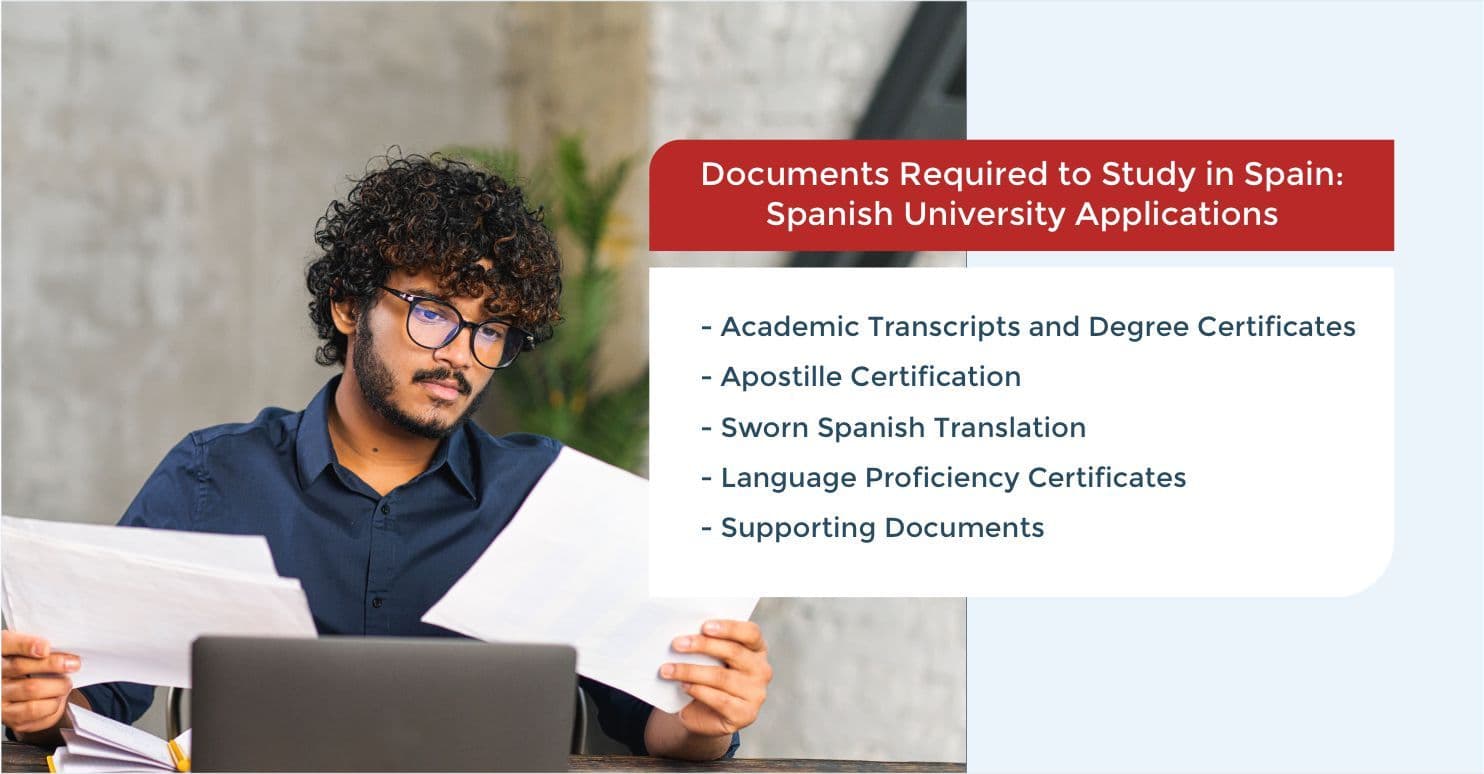
Regardless of whether you are applying for a Grado, Master, or Doctorado in Spain, universities will require a core set of standardized documents. For Indian applicants, accuracy in format and certification is often more important than the documents themselves.
Academic Transcripts and Degree Certificates
Official documents issued directly by your institution and not portal printouts or photocopies. For a Master's application, Bachelor's degree certificate and all year-wise or semester-wise transcripts. For doctoral applications, both Bachelor's and Master's documentation.
Apostille Certification
Apostille certification is mandatory under the Hague Convention, of which India and Spain are members. Documents may be processed through digital or physical apostille routes depending on eligibility and document type, issued by India’s Ministry of External Affairs.
Sworn Spanish Translation
Documents not in Spanish or English must be translated by a Traductor Jurado- a sworn translator officially certified by the Spanish Ministry of Foreign Affairs.
Language Proficiency Certificates
English-medium programmes require proof of language proficiency such as IELTS (generally in the range of 6.0-7.0 depending on the programme) or equivalent TOEFL scores, while Spanish-medium programmes require DELE or equivalent certification, usually at B2 level.
Supporting Documents
Documents such as Statement of Purpose, Letters of Recommendation, CV (often in Europass format), passport, and proof of financial means are also required. Financial proof is commonly assessed against a monthly baseline (around €600 per month for visa purposes), though exact requirements depend on consulate rules and programme type.
Spain has no centralised application system equivalent to the UK's UCAS. You apply directly to each university through its own portal or admissions process. Private universities tend to be faster and more responsive. Whereas public universities are slower and more documentation-heavy, though their admissions offices are reliable once contacted directly..
For Master's programmes, application windows open between January to April for September entry. Competitive programmes in fields such as Engineering, Data Science, and Business may fill early, often by February or March. Applicants can usually apply with provisional documents, with final admission confirmed once official transcripts and degree results are submitted.
For doctoral (PhD) programmes, admissions are often flexible but depend on supervisor availability and funding cycles. The most effective approach is a targeted email to potential supervisors, including a clear research proposal and academic background. Generic enquiries without a defined research focus are less likely to receive responses.
| When | What to do |
| 16-18 months before | Research programmes, shortlist universities, check UNED PCE requirements if applying at undergraduate level |
| 12-14 months before | Initiate apostille process (e-Apostille or physical). Register for IELTS/TOEFL. Begin Spanish if applying to Spanish-medium programmes |
| 10-12 months before | Request official transcripts. For PhD applicants, begin contacting potential supervisors with research proposals. |
| 8-10 months before | Begin submitting applications as portals open (nearly January onwards for September intake). |
| 6-8 months before | Receive offers, confirm admissions, and begin scholarship applications if applicable. |
| 4-6 months before | Apply for a student visa at the Spanish consulate in India once admission is secured. |
| 1-2 months before | Arrange accommodation, health insurance, initial finances. |
| On arrival | Complete empadronamiento (municipal registration) within the first week. Book TIE appointment immediately |

