
The student visa is the part of the Spain journey that causes the most anxiety among Indian applicants and most of that anxiety comes from incomplete or outdated information. The Spanish student visa process is not particularly difficult. It is document-heavy and timeline-sensitive. The students who struggle are almost always those who started too late, used the wrong documents, or relied on information that had not been updated to reflect recent regulatory changes.
Below you will learn about which visa you need, what documents are required, where and how to apply in India, what happens after you arrive, work rights during your studies, and the post-study options. The information here reflects requirements as of 2026, but visa regulations do change, and you should always verify current requirements directly with the Spanish Embassy or Consulate in India before submitting your application.
Spain issues different visa categories depending on the length and nature of your stay. For Indian students, the relevant categories are:
Short-Stay Schengen Visa (Type C): Valid for stays of up to 90 days within any 180-day period across the Schengen Area. This is appropriate only for very short language courses or intensive programmes of less than three months. It does not allow you to enroll in a degree programme and does not permit work. Most Indian students planning to study in Spain do not need this visa.
Long-Stay Student Visa (Type D): This is the visa you need for any programme lasting more than 90 days, which includes virtually all university degrees, most language courses of meaningful duration, and any programme leading to a qualification. The Type D student visa is issued for the duration of your programme, typically one academic year at a time, and is renewable from within Spain.
There is also a subcategory distinction within the Type D visa based on programme length:
The TIE is not just a bureaucratic formality. It is your primary identification document in Spain as a non-EU resident, and you will need it for opening a bank account, accessing healthcare, signing a rental contract, and any employment-related process.
Spain's student visa applications in India are handled through BLS International- the official outsourced visa application service authorised by the Spanish government. You do not submit directly at the consulate. You book your appointment through BLS, submit documents at a BLS centre, and BLS forwards everything to the relevant consulate for assessment and decision.
BLS centres are available across multiple Indian cities including Delhi, Mumbai, Bangalore, Chennai, Kolkata, Hyderabad, and Ahmedabad. Always use the official BLS Spain visa portal to book appointments, confirm current document requirements, and check centre locations. BLS service fees are charged separately from the consulate visa fee and are non-refundable.
Which consulate processes your application depends on your permanent residential address:
| Consulate | States and territories covered |
| Embassy of Spain, New Delhi | Delhi NCR, UP, Rajasthan, Punjab, Haryana, HP, Uttarakhand, J&K, Ladakh, Bihar, Jharkhand, Odisha, West Bengal, Assam, Sikkim, Arunachal Pradesh, Nagaland, Manipur, Meghalaya, Mizoram, Tripura, Chandigarh, Lakshadweep, Andaman & Nicobar Islands |
| Consulate General, Mumbai | Maharashtra, Goa, Gujarat, Karnataka, Kerala, Tamil Nadu, Andhra Pradesh, Telangana, Chhattisgarh, MP, Dadra & Nagar Haveli, Daman & Diu, Puducherry |
Embassy of Spain, New Delhi: 4, Golf Links, New Delhi 110003 | emb.nuevadelhi.vis@maec.es | Mon–Fri, 09:00–13:00
Consulate General of Spain, Mumbai: Express Towers, 3rd Floor, Barrister Rajni Patel Marg, Nariman Point, Mumbai 400021 | cog.mumbai.vis@maec.es | Mon–Fri, 09:00–14:00
Important: India also has Honorary Consulates in Bangalore and Chennai. These cannot process visa applications for Indian nationals. Residents of Bangalore, Chennai, Kolkata, and surrounding states must apply through BLS, their applications will be processed by the Mumbai Consulate General.
Step 1: Secure your university admission.
Begin the visa process only after you have an acceptance letter. Applying without confirmed admission wastes time and risks rejection.
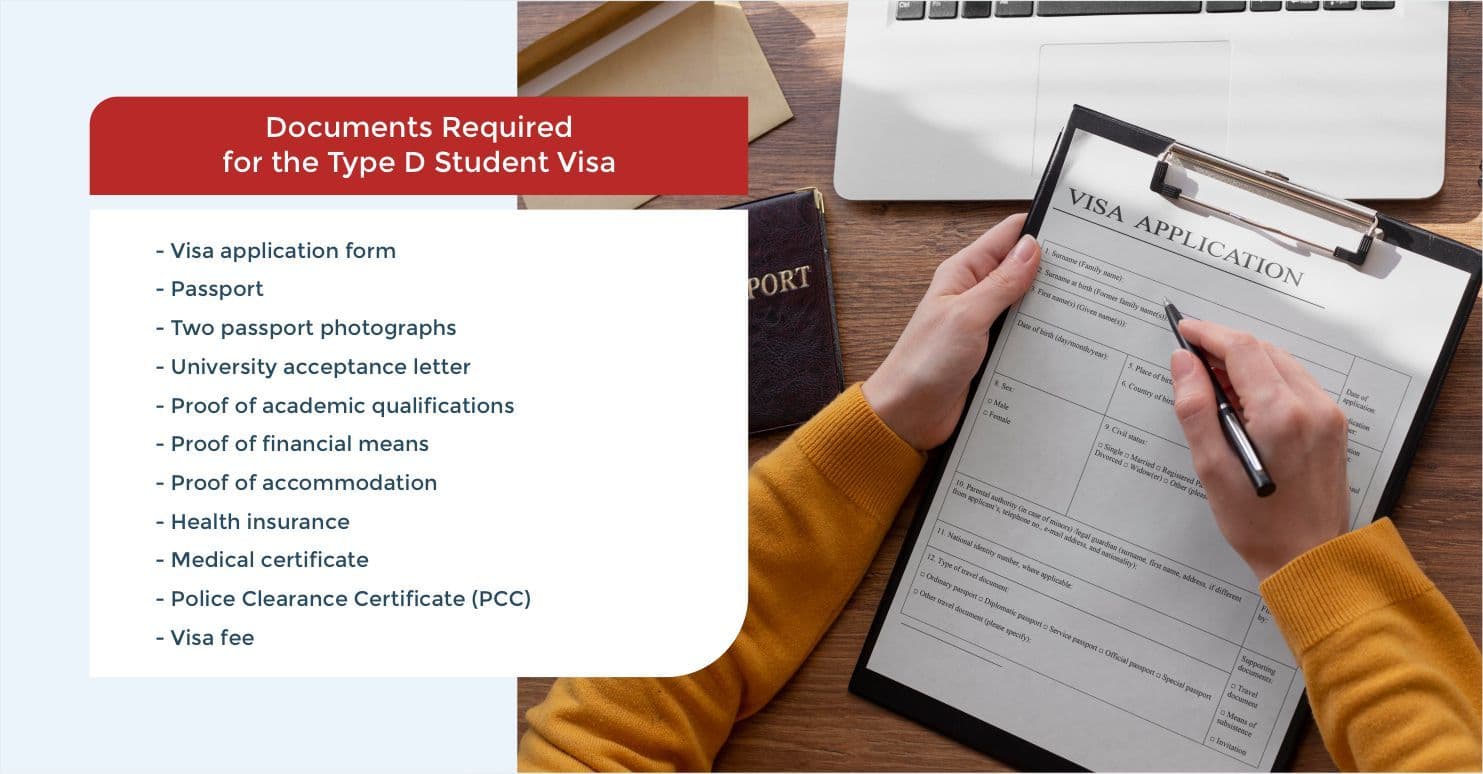
Step 2: Gather and authenticate your documents.
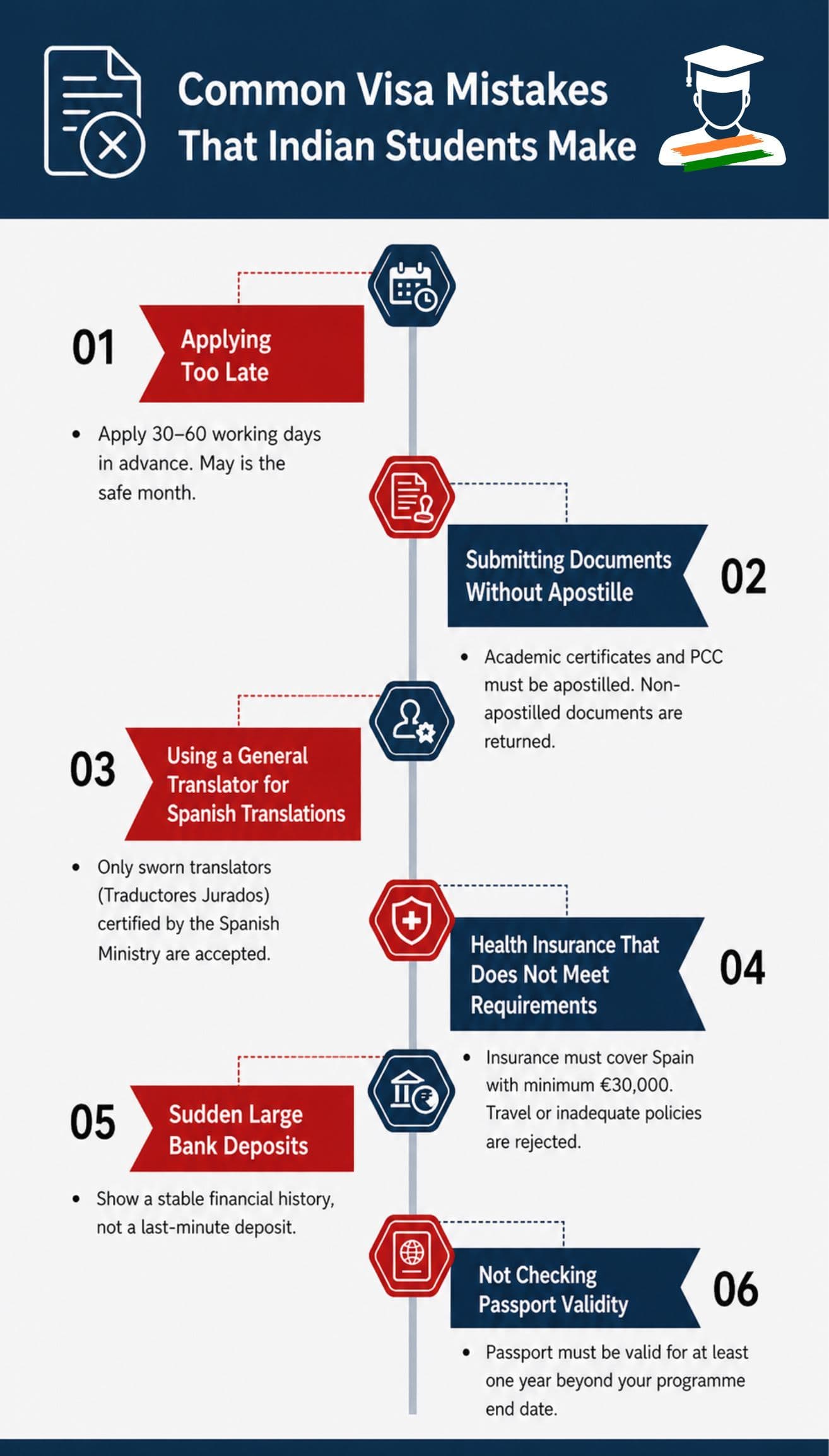
Start the apostille process for your academic documents and Police Clearance Certificate immediately after receiving your acceptance letter. These steps take the longest and are the most common source of delay. Do not wait until your other documents are ready before initiating the apostille process.
Step 3: Book your consulate appointment
Book your visa appointment through the official website of the Spanish Consulate or its authorised visa service provider (such as BLS International, depending on your jurisdiction). Appointments are limited and fill quickly, especially between May and July. If no slots are available, check daily as cancellations are common and new slots are released periodically.
Step 4: Submit your application.
Attend your appointment with your complete document set like originals and photocopies. Your biometric data (fingerprints and photograph) will be collected, and your application will be formally submitted to the consulate for processing. Incomplete applications are a common reason for delays or rejection, so ensure every document meets the stated requirements before your appointment.
Step 5: Wait for processing.
Standard processing time for a Spanish student visa from India is 30 to 60 working days. Processing times can extend during peak periods. Applying in May or June for a September intake is standard practice, but applying in March or April gives you more buffer for unexpected delays.
Step 6: Collect your visa.
Once approved, your passport will be returned with the visa sticker. Check all details on the visa like name spelling, validity dates, number of entries immediately. Errors must be corrected before you travel.
Step 7: Travel to Spain.
You must enter Spain within the validity window stated on your visa. Most Type D student visas allow entry up to 30 days before the programme start date.
Empadronamiento (municipal registration): Register your address at your local Ayuntamiento within the first week. It's free and hardly takes 30 minutes. You need your passport, visa, and proof of address. The certificate you receive is required for your bank account, healthcare access, and TIE application.
TIE application: Book your appointment at the local Extranjería office (National Police) immediately on arrival. Slots in Madrid and Barcelona are in high demand and can take several weeks to secure. Documents needed are passport, Type D visa, university enrolment certificate, proof of financial means, health insurance, and empadronamiento certificate. TIE card is usually take 8 to 12 weeks to be ready for collection in major cities. You receive a receipt as proof of legal status while you wait.
This is an important aspect of the student visa for Indian students, and Spain made a positive change here in 2023.
As of the updated immigration regulations that came into force following the passage of the Ley de Startups and associated immigration reforms, international students in Spain on a Type D student visa are permitted to work up to 30 hours per week during the academic term, and full-time during official academic holidays. This is an increase from the previous limit of 20 hours per week and brings Spain's student work provisions closer to those of the UK and Ireland.
The work authorisation is not automatic. Your employer must apply for a work permit on your behalf through the immigration authorities. You cannot simply take on work without this authorisation in place. The process is handled by the employer, but you need to understand it exists and confirm that any employer you work for is willing to go through it. Established companies and university-affiliated employers are familiar with the process. Informal or cash-in-hand arrangements are not legal and carry real risk.
The types of work available to Indian students in Spain will depend on their Spanish level. University campuses, international companies, English-language teaching, and hospitality in international tourist areas are the most accessible sectors. Professional internships in your field of study are also possible and can often be arranged through your university's career services department- these are frequently structured as curricular practices which are integrated into the degree and may not require separate work authorisation.
If your programme spans more than one academic year, which includes all four-year Grado programmes, two-year Master's programmes, and doctoral programmes then you will need to renew your student residence authorisation (TIE) annually from inside Spain rather than returning to India for a new visa.
The renewal is processed through the Extranjería office and requires proof of continued enrolment, proof of financial means for the coming year, and valid health insurance. The renewal should be initiated at least 60 days before your current TIE expires. Overstaying a lapsed TIE, even by a few days while a renewal is pending, can create complications that are time-consuming and stressful to resolve. Set a calendar reminder and initiate the renewal process early.
Spain introduced meaningful improvements and these changes are directly relevant to Indian students thinking about career options after graduation.
Job-seeking permit: International graduates who complete a university degree in Spain can now apply for a 12-month job-seeking permit after graduation. This allows you to remain legally in Spain while searching for employment, without needing to maintain your student status. The application is made at the Extranjería office before your student visa expires.
Startup visa provisions: Graduates who wish to launch a business or startup in Spain can apply for an entrepreneur visa under the new Ley de Startups framework, which provides a pathway to longer-term residence for those who can demonstrate a viable business plan and initial funding.
Transition to work visa: Once you secure employment in Spain after graduation, your employer can sponsor a work permit application that transitions your legal status from student to worker. This is a standard process and is the route most graduates who stay and work in Spain follow.