
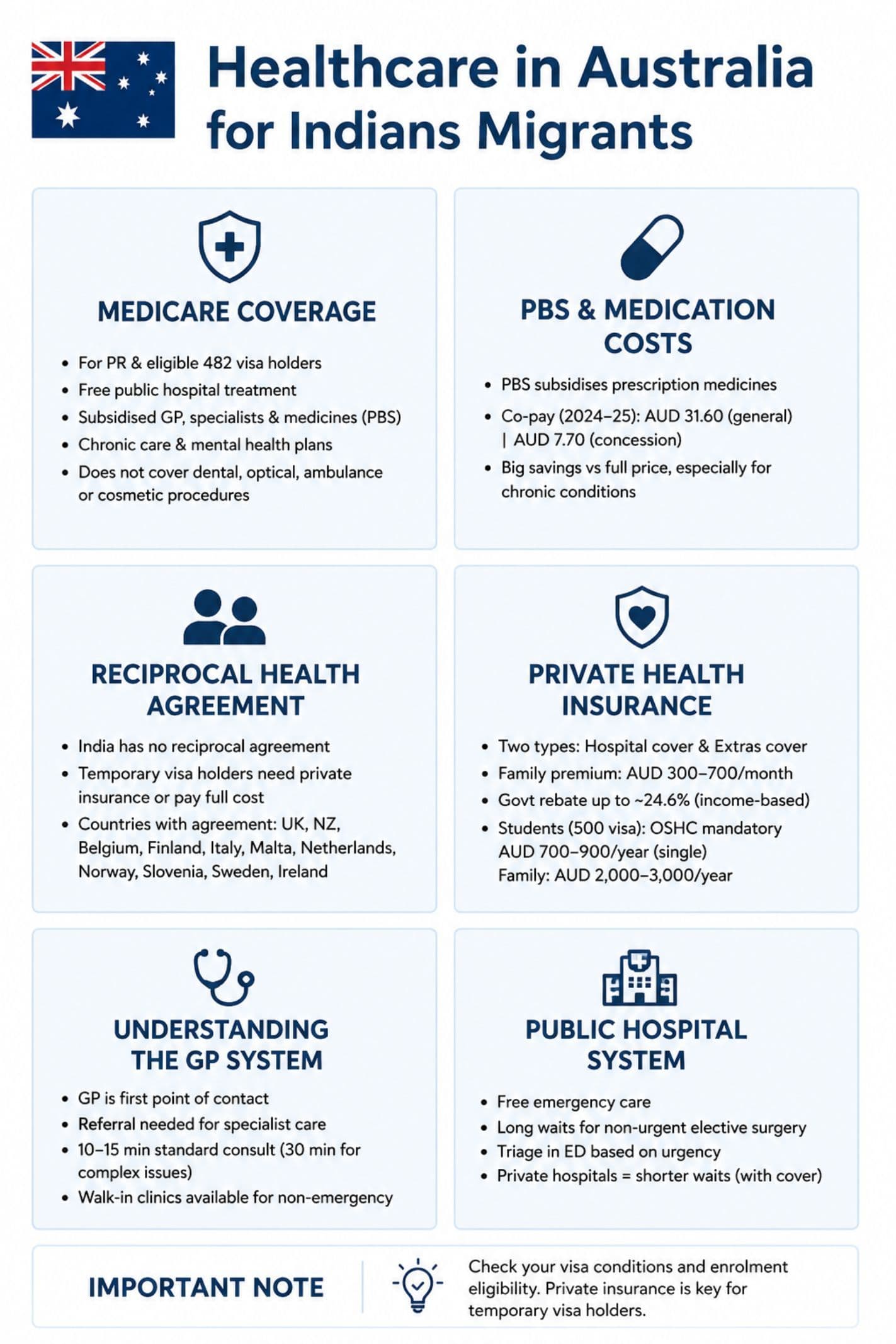
Australia operates a universal public health insurance scheme called Medicare. It covers Australian citizens and permanent residents. Temporary visa holders are not covered by Medicare unless they are from a country that has a reciprocal healthcare agreement with Australia.
However, holders of certain temporary work visas, including some 482 visa holders, may be eligible to enrol in Medicare under a Ministerial Order if their visa does not carry condition 8501. Check your visa grant letter and confirm eligibility with Services Australia before purchasing private health insurance.Medicare provides access to:
The Pharmaceutical Benefits Scheme subsidises many prescription medications. As of 2024–25, the maximum co-payment per PBS prescription is AUD 31.60 for general patients and AUD 7.70 for concession card holders. This is a significant reduction from the full cost of many medicines.
Indian migrants who manage chronic conditions (diabetes, hypertension, thyroid disorders, all common among Indian-origin populations) will find that PBS-subsidised medications are far cheaper than in India for high-cost pharmaceuticals, though cheaper generics widely available in India may not have an exact equivalent in Australia.India does not have a reciprocal healthcare agreement with Australia. This means Indian nationals on temporary visas (482, 485, 500, 309) are not eligible for Medicare. They must hold private health insurance or pay out-of-pocket for medical care.
Countries that do have reciprocal agreements with Australia include the United Kingdom, New Zealand, Belgium, Finland, Italy, Malta, the Netherlands, Norway, Slovenia, Sweden, and the Republic of Ireland.Private health insurance in Australia has two components:
General Practitioners (GPs) are the primary point of contact for medical care in Australia. All non-emergency specialist care requires a referral from a GP. This gatekeeper model is different from the more direct specialist access common in India.
GPs in Australia provide a wide range of services including chronic disease management, mental health assessments, vaccination, women's health, minor procedures, and referrals. Finding a regular GP ("My Doctor") and maintaining that relationship is important GPs who know their patients' histories provide better continuity of care.Appointments with GPs last 10–15 minutes for standard consultations. For complex issues, a long appointment (30 minutes) should be requested. Walk-in urgent care clinics exist in most suburbs for non-emergency acute issues when your regular GP has no same-day availability.Australia's public hospitals are funded by state and territory governments and the federal government. Wait times for elective procedures in public hospitals can be long months to years for non-urgent procedures such as joint replacements or hernia repairs. For urgent and emergency care, the public system is well-equipped and free at the point of care.
Emergency departments triage patients by clinical urgency using the Australasian Triage Scale (ATS). Category 1 (immediately life-threatening) is seen immediately. Category 5 (less urgent) may wait up to 2 hours. Waiting times for lower-category presentations in major city hospitals can be long.Major teaching hospitals associated with Group of Eight universities are particularly well-resourced. Royal Melbourne Hospital, Sydney Hospital, Princess Alexandra Hospital (Brisbane), and Royal Perth Hospital are among the flagship public institutions.Mental health support is available through:
Dental care is not covered by Medicare for adults. Routine check-ups, fillings, extractions, and orthodontic treatment are private costs. Dental care costs in Australia:

