
For decades, the default European dream for Indians meant the United Kingdom, Germany, or the Netherlands. Spain barely registered. It was seen as a country with high unemployment, a language barrier, and limited career opportunity for Indian professionals. That perception is now outdated, and the numbers quietly confirm it.
According to Spain's National Statistics Institute (INE), the Indian-origin population in Spain has been growing steadily year-on-year, concentrated in Madrid, Barcelona, Valencia, and increasingly in mid-sized cities like Malaga and Alicante. The profile of Indians arriving has also shifted from primarily traders and restaurateurs to IT professionals, remote workers, MBA graduates, healthcare workers, and entire families making long-term lifestyle decisions.
For Indian professionals and families, the United Kingdom was the automatic first choice for decades- shared language, established Indian community, familiar institutions. Post-Brexit, that equation fractured. The UK's immigration costs rose sharply, the Skilled Worker visa income thresholds were raised, and the path to settlement became longer and more expensive. Meanwhile, Spain being a full EU member, offers something the UK no longer can- once you have Spanish long-term residency or citizenship, you have the legal right to live and work across 29 European countries. That is a fundamentally different level of mobility, and Indians are noticing.
In 2023, Spain passed the Ley de Startups (Startup Act), one of the most progressive pieces of innovation legislation in Europe. This led to the creation of the Spain Digital Nomad Visa- a dedicated legal route for remote workers and digital freelancers to live in Spain while working for clients or employers based outside Spain. As of 2025, this visa is fully operational and has become the single most popular entry route for Indian IT professionals, designers, consultants, and remote-first workers making the move to Spain.
One of the reasons Indians are choosing Spain over Germany, France, or the Netherlands is the ratio of quality of life to cost. Spain consistently ranks among the top countries globally for healthcare quality, life expectancy, food quality, climate, and work-life balance while its cost of living remains lower than London, Amsterdam, or Munich.
For an Indian family relocating from a Tier-1 Indian city, the lifestyle upgrade is substantial without the financial shock of a London or Zurich relocation. A spacious apartment in Valencia or Seville costs a fraction of what an equivalent flat would in Berlin or Paris. Mediterranean food culture, while different from Indian cuisine, is vegetarian-friendly in a way that Northern Europe often is not. Spain's produce markets and strong vegetable culture make dietary adaptation far easier for Indian families than many expect.
Spain's economy is the fourth largest in the Eurozone and the sectors where Indian professionals are finding opportunities include:
One of the most common concerns Indians have about Spain, compared to the UK, Canada, or Australia, is the language. Spanish is essential for long-term life in Spain and this is not a country where English alone carries you through indefinitely.
In Madrid and Barcelona, English is widely spoken in professional and business settings, and you will manage in the short term. But for healthcare, dealing with bureaucracy, making friends outside the expat bubble, understanding your lease, or navigating your child's school - Spanish becomes necessary within the first year. Spanish is considered one of the easiest languages for English speakers to learn, language schools are affordable and excellent in Spain, and the immersive environment means most people become conversational within 12-18 months of consistent effort. For citizenship, a minimum DELE A2 Spanish language certificate is required, which most people achieve comfortably within two years of living in Spain.
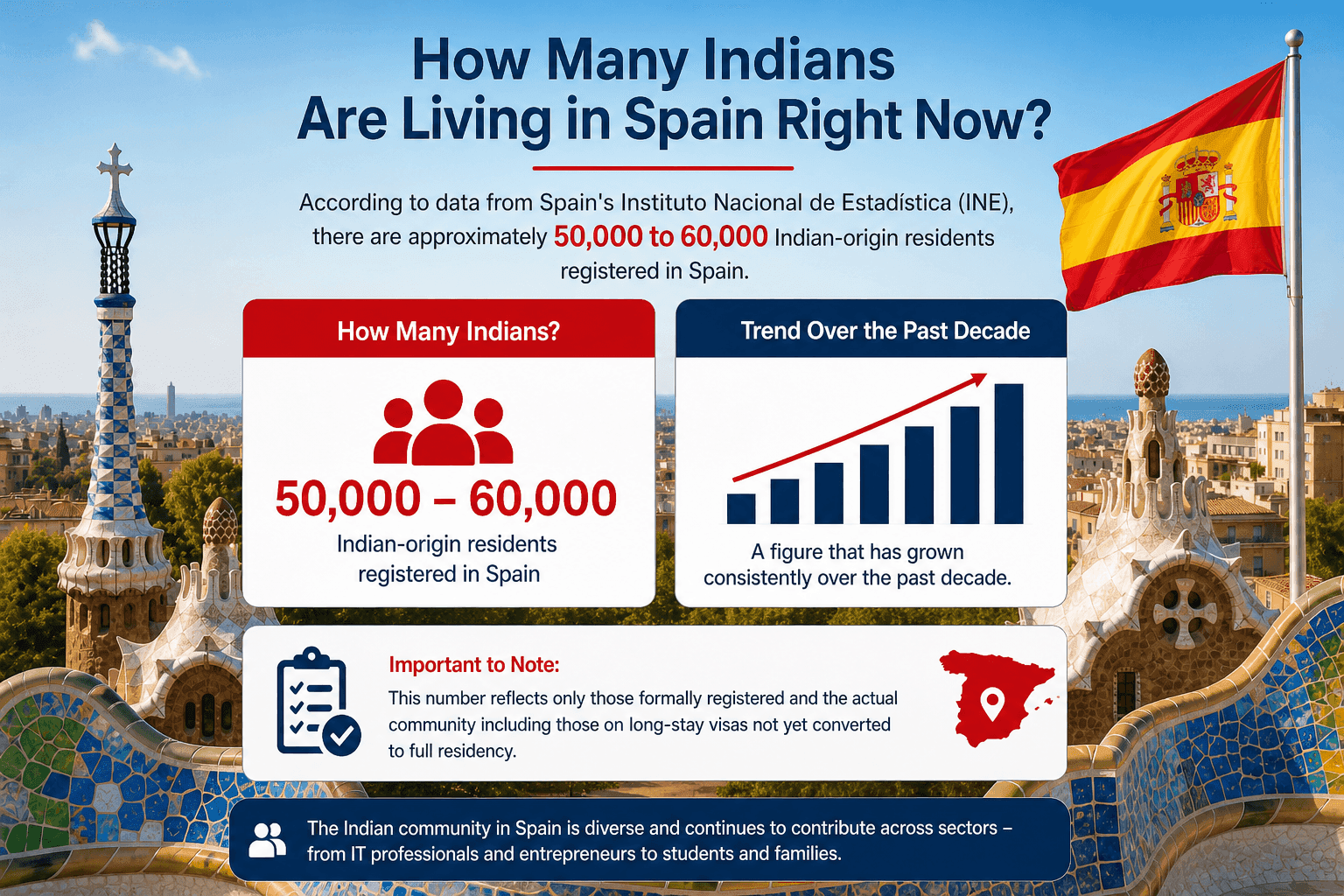
According to data from Spain's Instituto Nacional de Estadística (INE), there are approximately 50,000 to 60,000 Indian-origin residents registered in Spain, a figure that has grown consistently over the past decade. This number reflects only those formally registered and the actual community including those on long-stay visas not yet converted to full residency.
Where are Indians in Spain concentrated?
The profile has shifted meaningfully in the last five years. The earlier wave was dominated by traders, restaurant owners, and textile businesses who were Gujarati and Sindhi communities. The current wave is predominantly IT professionals, MBA graduates, healthcare workers, and remote-first entrepreneurs, with a growing number of entire families making permanent lifestyle relocations rather than temporary work postings. Indian students are also a rising segment, with Spain's affordable and internationally recognised universities attracting applicants who previously defaulted to the UK or Australia.
There are Hindu temples, Gurudwaras, Indian grocery stores, and active community associations in Madrid and Barcelona, with smaller community infrastructure developing in Valencia and Malaga. Diwali and Holi events are publicly celebrated in major cities. The community is young, educated, and still in the process of building the kind of deep institutional roots that Indian communities have in London or Toronto which also means it is a community you can shape and contribute to, not just join.

