

Guide for Moving to Spain from India (2026)
Guide

Guide for Moving to Spain from India (2026)

Chapters
Why Are Indians Choosing Spain?Understanding Legal Options for Indians Moving to Spain in 2026How to Actually Move to Spain from India in 2026: Step by Step ProcessTaxes for Indians Moving to Spain: 2026 GuideHealthcare for Indians Moving to Spain: 2026 OverviewEducation for Indian Children in Spain Indian Life in Spain: Community, Food, Culture and Daily LivingFrom Visa to PR to Spanish Citizenship: The Full Roadmap for IndiansWhat to Do With Your Indian Property When You MoveCommon Mistakes Indians Make When Moving to SpainHousing Options for Indians Moving to Spain in 2026
HomeGuidesGuide for Moving to Spain from India (2026)Housing Options for Indians Moving to Spain in 2026
Chapters

Housing Options for Indians Moving to Spain in 2026

We have two main options for housing in Spain. Either you can rent or you can buy a property in Spain.

Renting Property in Spain

For the first one to two years in Spain, renting is the sensible choice for the vast majority of Indians. The Spanish property market, the neighbourhoods, the quality of different buildings, and the differences between cities- all of this takes time to understand properly. Buying before you have lived in a city long enough to know it well is a risk.

Finding a rental: Spain's two dominant property portals are Idealista and Fotocasa. Both are well-established and list the vast majority of available rentals across Spain. Idealista tends to have the widest inventory. Most listings include detailed photos, floor plans, and direct landlord or agency contact.

What landlords ask for?

One to two months deposit, first month's rent upfront, and proof of income. For newly arrived Indians without Spanish payslips, this last requirement is where friction arises, some landlords and agencies are reluctant to rent to applicants whose income documentation is foreign. Practical solutions include offering a larger deposit, providing a bank guarantee from a Spanish bank, or showing substantial bank statements demonstrating financial stability. Having your employer provide an official offer letter or salary confirmation in Spanish also helps.

Madrid and Barcelona have the tightest and most competitive rental markets. For well-located apartments under €1,200. Starting your property search 6 to 8 weeks before your intended move date is advisable, and having your NIE and empadronamiento ready speeds up the contract signing process significantly.

Rental contracts in Spain are governed by Spain's Urban Leasing Law called as Ley de Arrendamientos Urbanos(LAU). Standard residential leases run for a minimum term of 5 years or 7 years if the landlord is a legal entity, with annual rent increases capped in line with the CPI or a government-set limit. You have the right to exit after 6 months with 30 days notice. Read your contract carefully, ideally with the help of a lawyer before signing.
Buying Property in Spain in 2026

chapter image

There are no restrictions on Indian nationals buying property in Spain. Non-EU foreigners can purchase residential and commercial property freely. The one critical update for 2025 is buying property in Spain no longer grants residency under the Golden Visa real estate route that was closed in April 2025. Property purchase is now purely a lifestyle or investment decision, not an immigration strategy.

How to buy a property?

You need your NIE before any property purchase can be completed, it is required for the notary deed and all financial transactions. Once you identify a property, the standard process involves signing a reservation contract- often with a €3,000 - €10,000 deposit followed by a 10% deposit (Arras contract) to lock in the price. The final purchase deed is signed before a Spanish notary , at which point the balance is paid and ownership transfers.

Costs of buying in Spain:

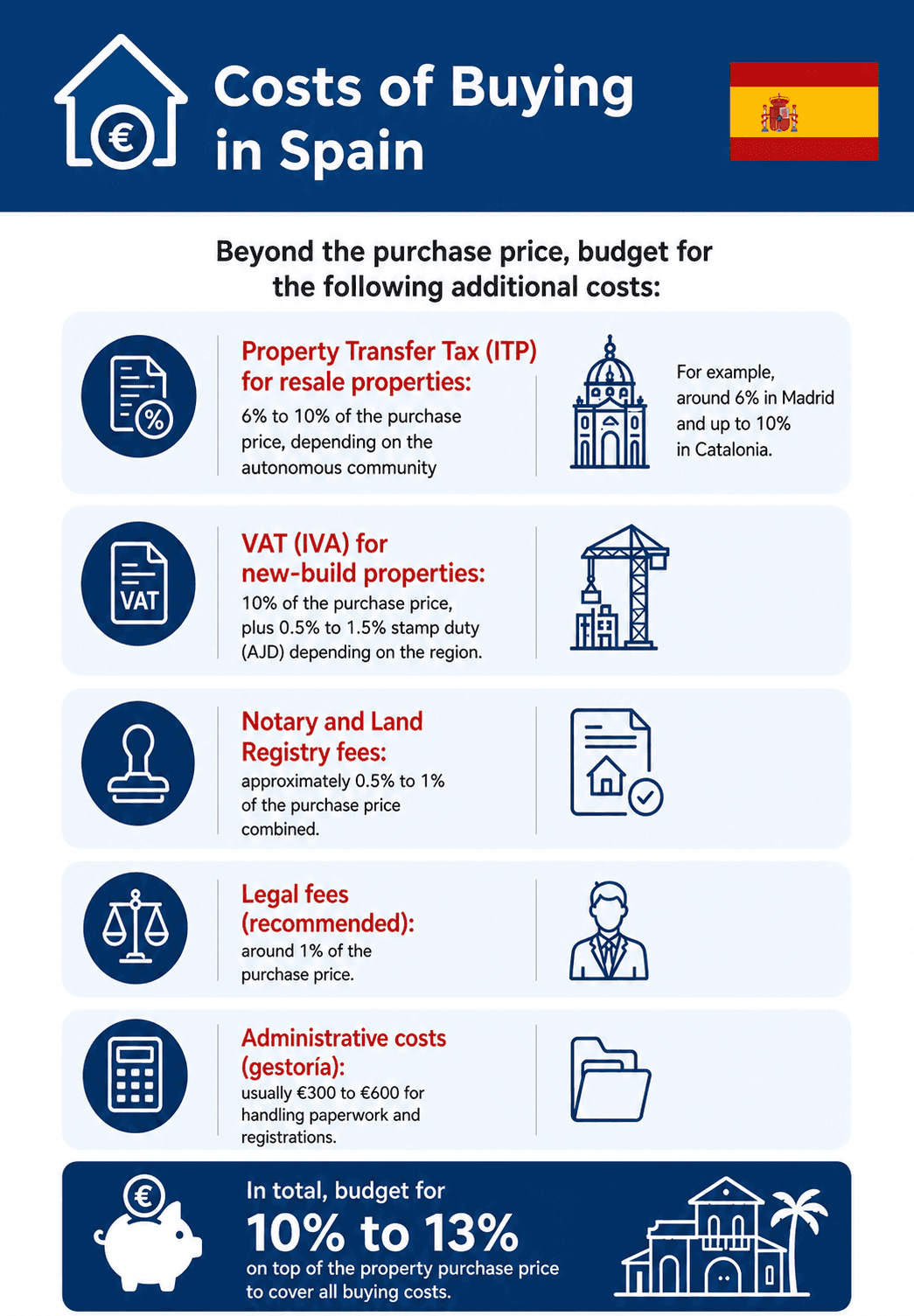
Beyond the purchase price, budget for the following additional costs:

  • Property Transfer Tax (ITP) for resale properties: 6% to 10% of the purchase price, depending on the autonomous community (for example, around 6% in Madrid and up to 10% in Catalonia).
  • VAT (IVA) for new-build properties: 10% of the purchase price, plus 0.5% to 1.5% stamp duty (AJD) depending on the region.
  • Notary and Land Registry fees: approximately 0.5% to 1% of the purchase price combined.
  • Legal fees (recommended for non-Spanish buyers): around 1% of the purchase price.
  • Administrative costs (gestoría): usually €300 to €600 for handling paperwork and registrations.

In total, budget for 10% to 13% on top of the property purchase price to cover all buying costs.

Mortgages for Indian nationals in Spain:

Spanish banks do offer mortgages to both resident and non-resident foreign buyers, including Indians. As a non-resident, banks lend around 60% to 70% of the property value, with requirements depending on your income profile and country of residence.

As a Spanish tax resident with a stable income history in Spain, you can access more standard mortgage conditions, usually up to 80% of the property value for a primary residence. Approval is also influenced by affordability rules, with monthly repayments expected to remain within 30–35% of your net income.

Having a Spanish bank account, a stable employment contract, or demonstrable income improves your eligibility and the terms offered.

Best time to buy: Most Indian expats in Spain who have purchased property recommend waiting at least 2 to 3 years after arriving before buying. Long enough to know your city well, establish financial stability in Spain, and make the decision from a position of knowledge rather than urgency.

Conclusion

Moving to Spain from India is not a small decision but it is increasingly a well-considered one, and for good reason. Spain offers world-class healthcare, affordable European living, a legal framework built for modern professionals, and a path to one of the most powerful passports in the world. The process demands patience and preparation of the visas, the apostilles, the bureaucracy but Indians who have made the move consistently say the same thing that the life on the other side is worth it.

Frequently Asked Questions

Yes, and more are doing it every year. But it easily depends on how prepared you are. Spain has real, well-defined routes for Indian nationals: the Digital Nomad Visa for remote workers, the Work Visa for employer-sponsored moves, the Student Visa, the Non-Lucrative Visa for those with passive income, and the EU Blue Card for highly qualified professionals. None of these are fast. The apostille process alone takes four to eight weeks. BLS appointment slots in Mumbai and Delhi fill up weeks in advance. Get your visa category right first, start your documents early, and the process is entirely manageable.
As a general benchmark, a single professional needs at least €2,000 to €2,500 per month to live comfortably in Madrid or Barcelona, and €1,400 to €2,000 in cities like Valencia or Seville. Beyond monthly costs, budget for initial setup expenses like rental deposit, visa fees, apostille costs, and BLS service charges, which can amount to €3,000 to €5,000 upfront before you settle in.
Yes but only for employers or clients based outside Spain. Up to 20% of your total income can come from Spanish sources. You cannot take up local employment with a Spanish company on a DNV. If you want to work for a Spanish employer, you need a Work Visa or EU Blue Card instead.
Spain is an excellent destination for Indian families. Public schooling is free, healthcare is universal, the cost of living is lower than most of Western Europe, and the Mediterranean lifestyle suits Indian families well. The main considerations are the Spanish language requirement for daily life and schooling, and limited Indian community infrastructure outside Madrid and Barcelona.
Madrid has the largest Indian community, best job market, and most established Indian infrastructure like groceries, temples, community networks. Barcelona suits those in tech and startups. Valencia offers the best quality of life to cost ratio for remote workers and families. Málaga is growing fast as a tech and digital nomad hub. The best city depends on your profession, budget, and lifestyle priorities.
Indians can apply for long-term EU residency after 5 years of continuous legal residence in Spain. This is a permanent status that also grants the right to live and work across most EU member states. The 5-year count begins from your first day of legal residence, so maintaining continuous and uninterrupted residency from the start matters.
Yes after 10 years of continuous legal residence in Spain. You must pass a Spanish language test (minimum DELE A2) and a civics test (CCSE), demonstrate clean criminal records from both Spain and India, and renounce your Indian citizenship as India does not permit dual nationality. The process is managed through Spain's Civil Registry and currently takes 1 to 3 years to process after application.
No. India does not permit dual citizenship under its Constitution. Taking Spanish nationality requires formally renouncing your Indian citizenship. Most Indians who naturalise as Spanish citizens subsequently apply for an OCI (Overseas Citizen of India) card, which provides lifelong visa-free access to India and most rights except voting and holding public office.
English is sufficient in professional settings in Madrid and Barcelona for the short term. But for the long term, healthcare, bureaucracy, schooling, daily life, and social integration- Spanish is essential. A minimum DELE A2 certificate is required for citizenship. Most Indians living in Spain become conversational within 12 to 18 months of consistent learning and immersion.
Yes, for Indians who are legally resident and registered with Spain's Social Security system, public healthcare is free and comprehensive, covering GP visits, specialist care, hospital treatment, and subsidised prescriptions. Indians on visa categories that do not require Social Security registration such as the Non-Lucrative Visa, must maintain private health insurance instead.
Once you become an NRI, you cannot open new PPF accounts but can maintain existing ones until maturity. Your EPF can be withdrawn after leaving Indian employment, though withdrawing before 5 years has tax implications. Mutual funds can be held as an NRI, though some fund houses have country-specific restrictions. All Indian assets above €50,000 must be declared to Spanish tax authorities under Modelo 720.
Indian nationals who qualify can benefit from Spain's Beckham Law, which offers a flat 24% income tax rate for the first six years of Spanish residency instead of progressive rates up to 47%. You must apply within 6 months of registering with Spanish Social Security. Missing this window means losing the benefit permanently. DNV holders and employees transferred to Spain both potentially qualify.
Bringing parents under Spain's family reunification rules is only possible once you have long-term EU residency- after 5 years of legal residence. Before that, the most practical route for parents is to apply independently for a Non-Lucrative Visa, provided they can demonstrate sufficient passive income (approximately €2,400 per month). Parents cannot be included in a family reunification application during your initial residency years.
Yes, Spain is cheaper than the UK in many ways. Rent in Madrid or Barcelona is roughly 40% to 50% lower than equivalent accommodation in London. Healthcare is free under the public system versus the NHS which, while free, has longer wait times and an increasingly strained service. Indian professionals who qualify for Spain's Beckham Law flat tax rate of 24% often find their net financial position in Spain comparable to or better than the UK, despite nominally lower gross salaries.
Core documents required for most Spanish long-stay visa applications include a valid passport, police clearance certificate (PCC), educational degree certificates, proof of income or employment, and health insurance. All Indian government-issued documents must be apostilled by India's Ministry of External Affairs (MEA) and translated into Spanish by a sworn translator. The apostille process takes 4 to 8 weeks so start early.
Yes, there are no restrictions on Indian nationals purchasing property in Spain. However, as of April 2025, buying property no longer grants Spanish residency under the Golden Visa real estate route has been abolished. Property purchase is purely a lifestyle or an investment decision.
In This Chapter
Share This Guide
Share This Guide
Share This Guide